
Arqen Perps
Trade perpetual futures on any Solana token. You keep your funds. We pay the gas.
What Arqen Perps is
A perpetual future, or a “perp”, lets you bet on a token’s price going up or down without ever owning the token. You put up some money as margin, choose how much exposure you want, and your profit or loss tracks the token’s price from that moment on. Unlike a traditional futures contract, it never expires. You close it when you want to.
Arqen Perps runs this on Solana, with three things that are unusual:
Who it is for
| If you want to… | Arqen Perps gives you |
|---|---|
| Go long or short a small-cap token | A market that may not exist anywhere else |
| Trade without holding SOL for gas | Every fee sponsored, including failed attempts |
| Keep custody of your funds | Withdraw authority never leaves your wallet |
| Earn on idle USDC | Back a market and take the other side of the flow |
| List a market for your own token | Permissionless creation from any mint |
What this is not
Leverage magnifies losses exactly as much as it magnifies gains. A position at 10× is closed out by a 5% move against you. Most people who trade leverage lose money. Nothing on this site is financial advice, and you should not trade with money you cannot afford to lose.
Arqen is also young. Markets are thin, per-market size limits are real, and the system depends on a keeper process staying healthy. Those limits are documented rather than hidden. See Fees & limits.
Architecture
Four moving parts, and a clear line between the one that holds your money and the ones that do not.
The pieces
When you place a trade, four systems are involved. The important thing is which of them can touch your funds, and the answer is only one: the on-chain program, and only in ways you signed for.
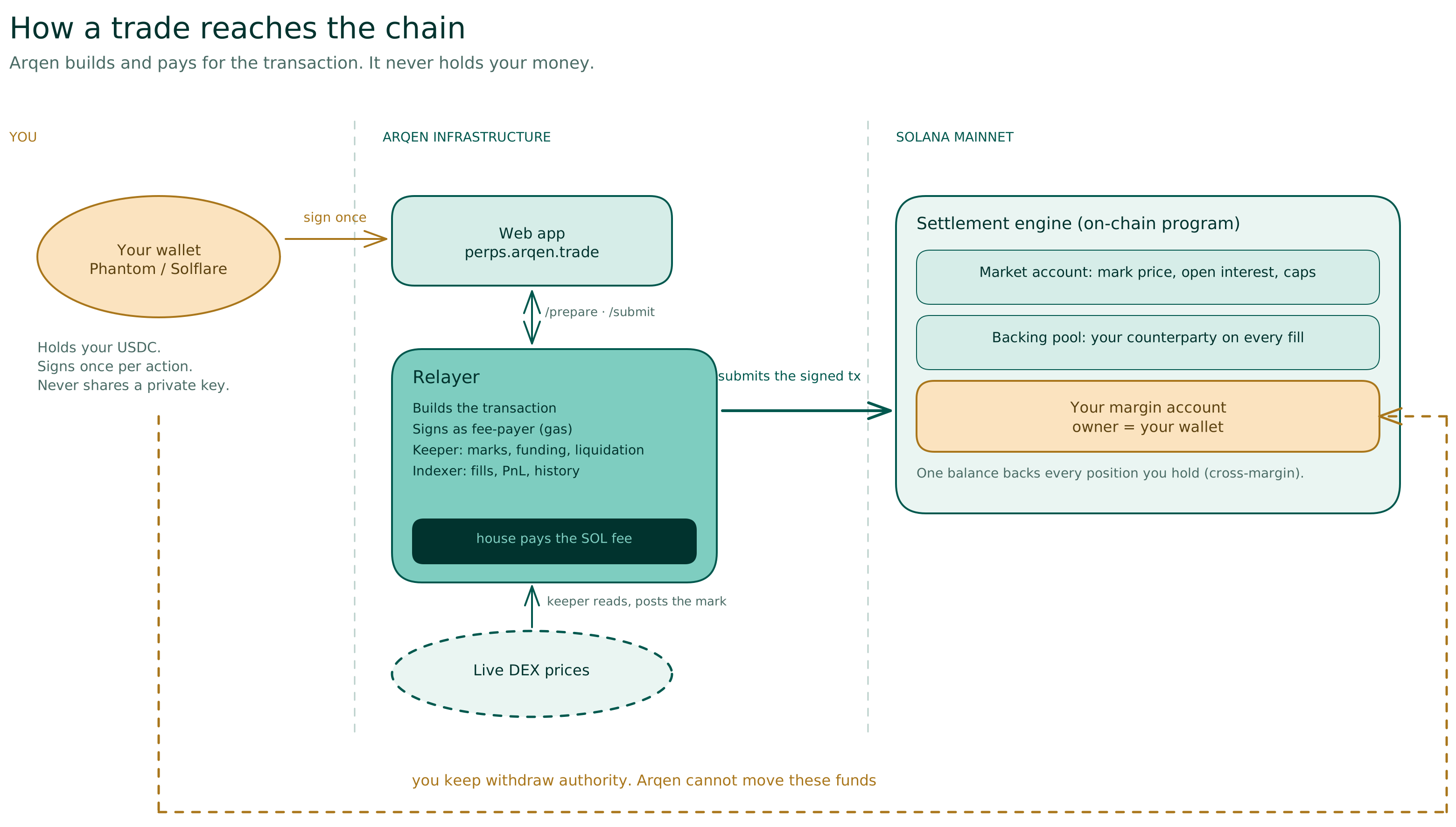
| Part | What it does | Can it move your funds? |
|---|---|---|
| Your wallet | Holds your USDC. Signs each action. | Yes, only you |
| Web app | Shows prices, sizes the trade, displays your positions. | No |
| Relayer | Builds transactions, pays network fees, runs the keeper and indexer. | No |
| Settlement engine | The on-chain program. Holds margin, marks, positions. | Only as the code allows |
Why self-custody is real here
Your margin lives in a margin account on Solana whose owner is your wallet address. The relayer builds transactions that touch it, but every one of those transactions needs your signature to be valid. There is no path by which Arqen withdraws your balance, because the on-chain program will not accept an instruction that tries.
The practical test: if Arqen’s servers went offline permanently, your funds would still be on Solana, still owned by you, and still withdrawable by interacting with the program directly.
Where the truth lives
Anything that affects money is on-chain. Everything the relayer stores is a convenience copy that can be rebuilt.
| Data | Lives in | If it were lost |
|---|---|---|
| Your balance, positions, marks, backing | Solana | Nothing is lost; this is the source of truth |
| Trade history, PnL charts, leaderboard | Relayer database | Charts and history would rebuild; no funds affected |
| Theme, last market, local activity feed | Your browser | Cosmetic only |
Anatomy of a trade
From click to open position, with the numbers you actually see.
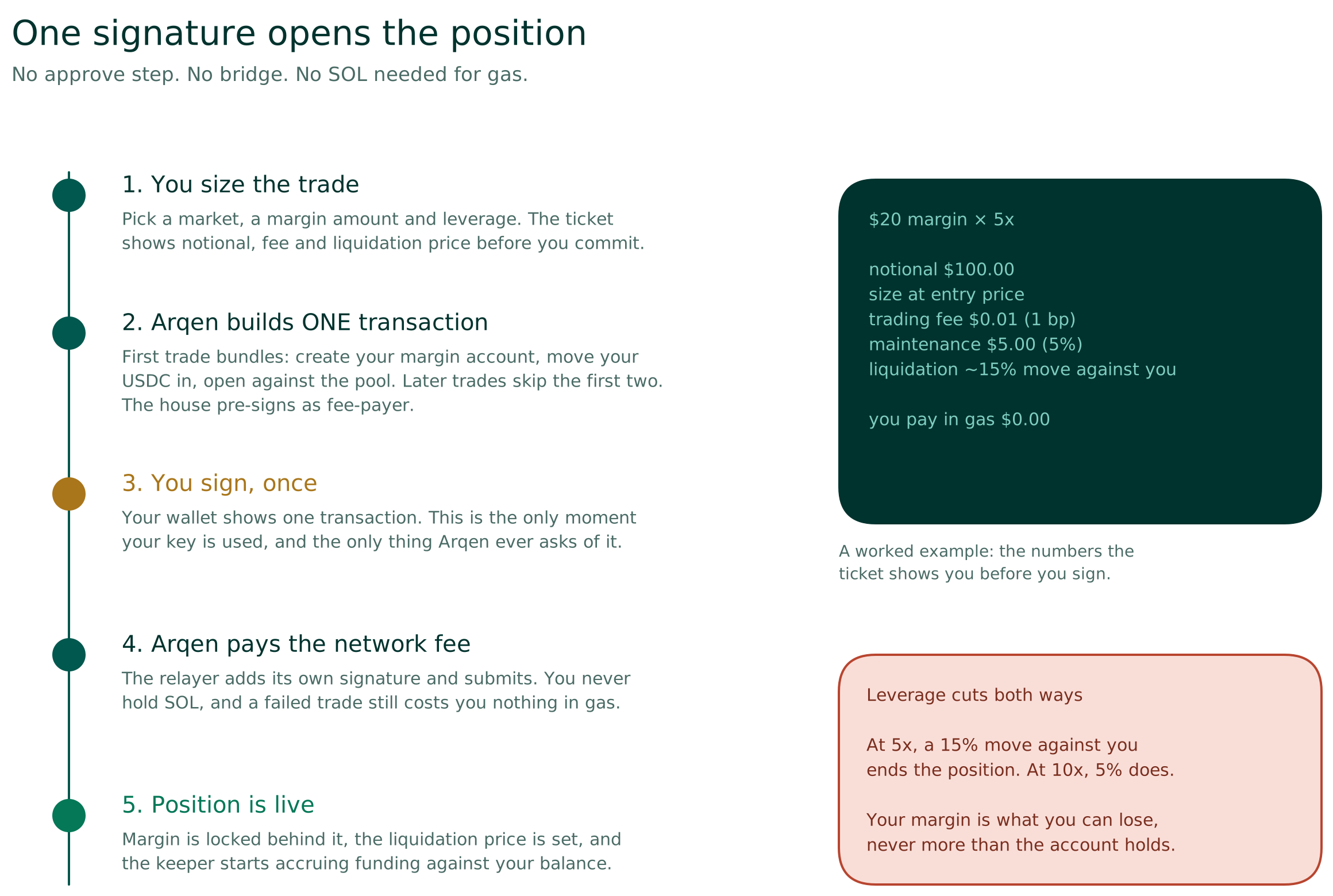
Five steps, one signature
Opening a leveraged position on most venues means approving a token, bridging funds, holding the chain’s gas token, and signing several times. Here it is one signature.
How a position is sized
Two numbers decide everything: how much margin you put up, and what leverage you choose.
With $20 of margin at 5× you control a $100 position. If the token rises 10%, that position is worth $110. You are up $10, which is a 50% gain on your margin. If it falls 10%, you are down $10, or half your margin. That is leverage in both directions.
Your first trade vs every trade after
The very first position also has to create your margin account and move your USDC into it. Arqen bundles all of that into the same single transaction, so it still costs you one signature. Later trades skip those steps because your collateral is already posted.
Closing
Closing is the same shape in reverse: one signature, gas sponsored. You can close the whole position or part of it. Your realised profit or loss settles in USDC into your account balance immediately, and the trade appears in your history with a link to the transaction on Solscan.
Margin & leverage
One balance, many positions, and the number that decides when it ends.
You have an account, not a market
You deposit once, into your own margin account. That single balance backs every position you hold, across every market. This is called cross-margin.
Your balance splits into two parts at any moment:
| Part | Meaning | Can you withdraw it? |
|---|---|---|
| Used margin | Locked behind your open positions | Not until you close or reduce them |
| Free collateral | Idle, available for new trades | Any time |
When a position is closed out
Arqen requires your equity (your balance plus any unrealised profit or loss) to stay above a maintenance floor of 5% of your notional. Fall below it and the position is liquidated.
That gives a simple rule of thumb for how far the price can move against you:
| Leverage | Position from $20 | Move against you before liquidation |
|---|---|---|
| 2× | $40 | ~45% |
| 5× | $100 | ~15% |
| 10× | $200 | ~5% |
On a volatile small-cap token, a 5% move can happen in a minute. That is the honest cost of 10×.
Your loss is capped
Liquidation is deliberately triggered before your equity reaches zero, leaving a buffer. You cannot end a trade owing Arqen money. The most you can lose is what is in your account.
Marks, funding & the keeper
What keeps a contract with no expiry tethered to the real price.
The mark price
Arqen never holds the token you are trading. A market’s price is a mark, a number posted on-chain, read from live decentralised exchange prices and validated across sources. Your profit and loss is calculated against that mark and settled in USDC.
This is why any liquid token can be listed almost instantly: all that is needed is a dependable price feed and USDC backing, not an inventory of the token itself.
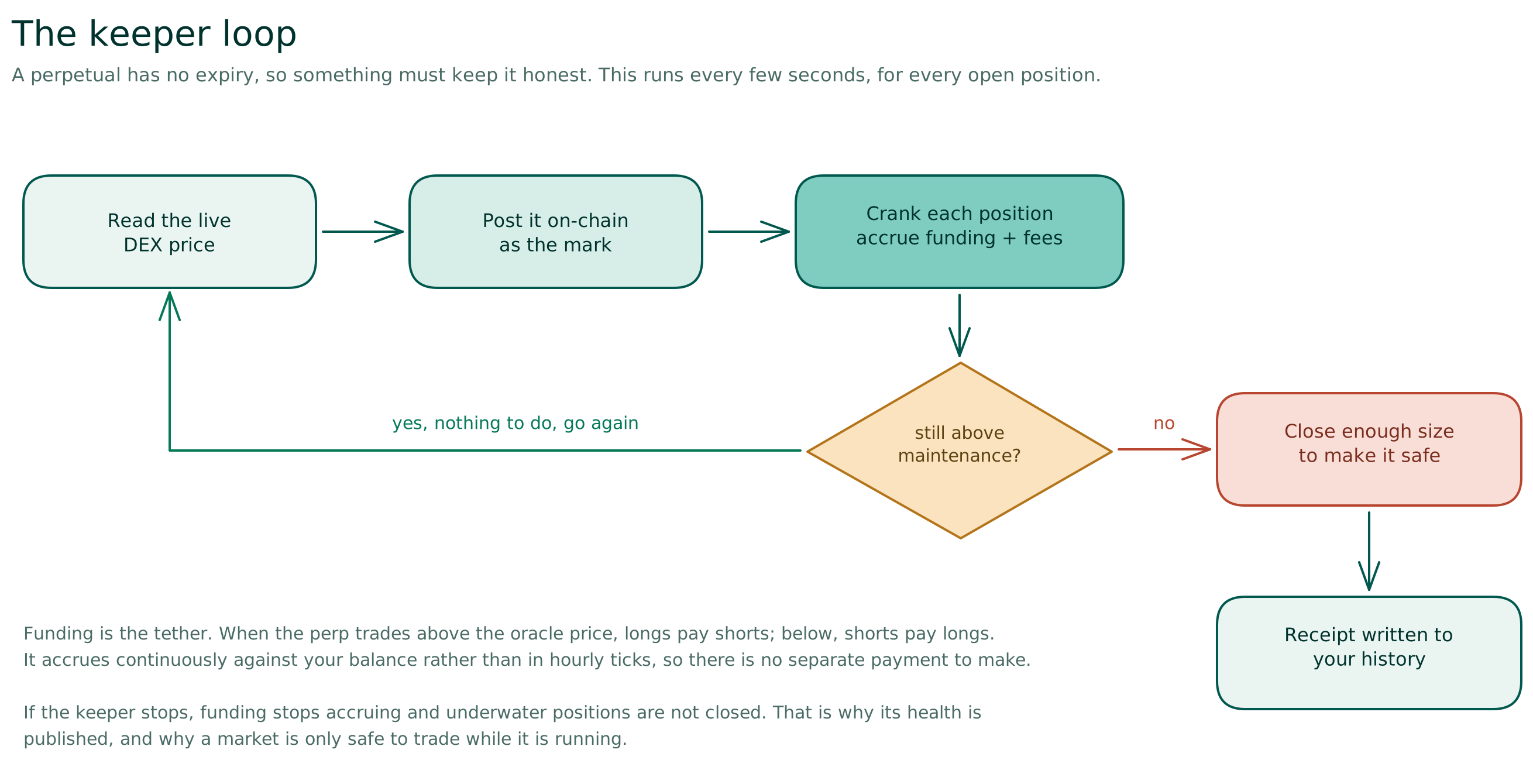
The keeper loop
A background process, the keeper, runs continuously. It posts fresh marks, charges funding, and closes positions that have fallen below their maintenance floor.
Funding, in plain terms
A perp has no expiry date, so nothing naturally forces its price back to reality. Funding is that force. It is a small ongoing payment between the two sides of the market:
| When the perp trades… | Then… | Why |
|---|---|---|
| Above the real price | Longs pay shorts | Makes being long costly, pulling the price down |
| Below the real price | Shorts pay longs | Makes being short costly, pulling the price up |
The rate grows with the size of the gap. It accrues continuously against your balance rather than in discrete hourly payments, so there is never a separate bill to settle. You simply see it in your account. The trade view shows the current rate as Funding / 1h.
Liquidation
What happens when a position runs out of room, and who absorbs the loss.
How it happens
Each time the keeper cranks your position it compares your equity against the maintenance floor. If you are below it, the engine closes as much size as it needs to to bring the account back to safety, often not the entire position.
Liquidation is permissionless: anyone can crank an underwater position, not just Arqen. A small liquidation fee of 5 bps is paid out of the position to whoever does it, which is what makes the system self-healing rather than dependent on one server staying up.
You always get a receipt
A forced close is written into your trade history like any other fill, labelled Liq, with the realised loss shown. A position can never simply vanish from your account without explanation.
Bad debt is walled off per market
In a fast crash a position can lose more than its margin before anyone can close it. That shortfall has to be absorbed by someone. On Arqen it is absorbed in a strict order, and it cannot cross market boundaries:
Creating a market
Paste a token address, seed the backing, own the market.
Why markets need backing
There is no order book here and no trader on the other side of your fill. The backing pool is your counterparty. When you win, the pool pays you; when you lose, the pool collects. A market therefore cannot exist until someone puts up capital to be that counterparty.
That person can be you. Whoever seeds a market owns it and can reclaim their backing later.
How to create one
Backing and capacity
Backing does not only enable a market, it sizes it. The exchange caps how much open interest a market may carry relative to the capital behind it, so a market can never write more risk than it can pay out.
The trade view shows this directly:
| Shown as | Meaning |
|---|---|
| Backing | Total capital standing behind this market |
| Capacity | Open interest currently used, against the ceiling |
| Max position | The largest single position you can open right now |
Reclaiming your backing
Owners can add backing at any time, and withdraw it when the market is flat, meaning when no positions are open against it. The restriction exists because that capital is what guarantees open positions can be paid out; releasing it early would strand traders.
Earn
Take the other side of the flow, and get paid for it.
How earning works
Depositing into a vault makes you part of the pool that is the counterparty to every trade in that market. Your return comes from two places:
| Source | Effect |
|---|---|
| Trading fees paid into the pool | Always adds |
| Trader losses | Adds |
| Trader profits | Subtracts |
Share price, not promises
When you deposit you receive shares at the current share price, which starts at $1.00. As the pool earns, the share price rises; when traders win, it falls. Your balance is simply your shares multiplied by the current price.
The advertised APR is not a projection or a token emission. It is measured from what actually happened:
Withdrawals cannot strand traders
You can withdraw the pool’s free liquidity at any time. Capital that is currently committed against open positions stays until those positions close. This gate is what guarantees a winning trader can always be paid.
Quick start
From an empty wallet to an open position.
What you need
| Requirement | Detail |
|---|---|
| A Solana wallet | Phantom or Solflare, on desktop or mobile |
| USDC on Solana | This is your margin and your settlement currency |
| SOL for gas | Not required. Arqen pays every network fee |
Five steps
Wallet warnings
Some wallets show a caution banner for domains they have not seen before. This is an automated reputation score based on domain age, not a finding about Arqen. Always confirm you are on perps.arqen.trade before signing anything.
Fees & limits
Every cost, and every ceiling, in one place.
What you pay
| Cost | Amount | When |
|---|---|---|
| Network gas | $0.00 | Never. Sponsored, including failed attempts |
| Trading fee | 1 bp (0.01%) | On notional, when you open and close |
| Price impact | varies | Larger orders fill slightly worse; shown before you sign |
| Funding | varies | Continuously, and it can be positive for you |
| Liquidation fee | 5 bps (0.05%) | Only if you are liquidated |
| Deposit / withdraw | $0.00 | Never |
A $100 position costs about one cent to open. The costs that actually matter at scale are price impact on thin markets and funding on a position held a long time.
Limits
| Limit | Value | Why |
|---|---|---|
| Maximum leverage | 10× | Higher leverage on thin tokens liquidates almost immediately |
| Maintenance margin | 5% of notional | The floor your equity must stay above |
| Maximum position | per market | Derived from that market’s backing and remaining capacity |
| Minimum backing to create | $5 | Pilot setting, to let small wallets create real markets |
Collateral
All margin, profit, loss and funding is denominated in USDC on Solana mainnet. You never need to hold SOL.
FAQ & glossary
Short answers, and the words this documentation uses.
Common questions
Do I need SOL?
No. Every network fee is paid by Arqen. You only need USDC.
Can Arqen take my money?
No. Your margin sits in an account owned by your
wallet, and the on-chain program rejects any instruction that tries to move it without your
signature.
Am I trading the real token?
No. You are trading a contract whose price
tracks the token. Nobody holds the token, and settlement is in USDC. This is what makes listing
any token possible.
Who is on the other side of my trade?
The market’s backing pool, not
another trader. There is no order book.
Can I lose more than I deposit?
No. Liquidation is triggered before your
equity reaches zero, and any shortfall is absorbed by that market’s backing and insurance.
Why is the maximum position so small?
Because that market’s backing is
small. Capacity is tied to the capital standing behind the market, on purpose.
Why did my wallet warn me about this site?
Automated reputation scoring based
on domain age. Verify you are on perps.arqen.trade and that the
transaction you are signing matches what you asked for.
Glossary
| Term | Meaning |
|---|---|
| Perp | A futures contract with no expiry date |
| Margin | The money you put up to open a position |
| Notional | The full size you control: margin × leverage |
| Mark | The on-chain price a market settles against |
| Funding | Ongoing payment between longs and shorts that tethers the perp to the real price |
| Maintenance margin | The equity floor, 5% of notional, below which you are liquidated |
| Cross-margin | One balance backing every position you hold |
| Free collateral | Balance not locked behind open positions; withdrawable |
| Backing | Capital that acts as counterparty for one market |
| Open interest | Total size of all open positions in a market |
| Keeper | The process that posts marks, charges funding and liquidates |
| Relayer | The service that builds transactions and pays network fees |